

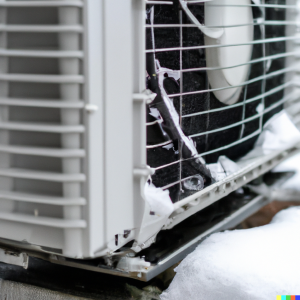
Why air source heat pumps are less effective during cold months
Air source heat pumps (ASHPs) are a popular alternative to traditional heating systems because they are energy efficient, environmentally friendly, and can save homeowners money on their energy bills. However, one drawback of ASHPs is that they are less effective during cold months. In this blog post, we will explore why ASHPs are less effective during cold months and what can be done to mitigate their limitations.
Firstly, it’s important to understand how ASHPs work. They operate by absorbing heat from the outside air and transferring it inside your home to provide warmth. However, when the outside temperature drops, the amount of heat available for the ASHP to extract decreases, which can result in less efficient heating.
In fact, the efficiency of an ASHP is measured by a term called the Coefficient of Performance (COP), which is the ratio of heat output to electricity input. The COP of an ASHP decreases as the temperature outside drops. For example, an ASHP may have a COP of 3.5 at 10°C, meaning it produces 3.5 units of heat for every unit of electricity consumed. However, when the temperature drops to -5°C, the COP may decrease to 1.5, meaning the ASHP produces only 1.5 units of heat for every unit of electricity consumed.
Another factor that contributes to the reduced effectiveness of ASHPs during cold months is the defrost cycle. When the outside temperature drops below freezing, the moisture in the air can freeze on the ASHP’s outdoor unit, forming ice. This ice reduces the ASHP’s ability to extract heat from the air, so the unit must go through a defrost cycle to melt the ice. During this cycle, the ASHP switches to cooling mode to warm up the outdoor unit, which can result in temporary cooling of the indoor space.
So, what can be done to mitigate the limitations of ASHPs during cold months? One solution is to install a backup heating system, such as a gas or electric furnace, to provide additional heating when the ASHP is less effective. Another solution is to install a larger ASHP that can provide more heat output at lower temperatures. Finally, regular maintenance and cleaning of the ASHP can help ensure it operates at peak efficiency and minimize the need for defrost cycles.
In conclusion, while ASHPs are an energy-efficient and environmentally friendly heating solution, they are less effective during cold months due to decreased heat availability and the need for defrost cycles. However, with proper maintenance and installation of a backup heating system, ASHPs can still be a great choice for many homeowners.

Leave a Reply