

Can Infrared Heating improve my EPC?
Introduction to Infrared Heating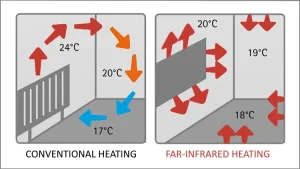
Infrared heating is an electric heating that does not use the surrounding air to transmit heat. Unlike other supplemental heating appliances, infrared heaters emit infrared radiation (far infrared) that warms the objects first and the air secondary, which makes them more energy efficient. This type of heating does not depend on convection to transfer heat, so it does not heat the air in your home. Therefore giving a better EPC rating.
Furthermore, many other benefits come alongside this type of heating, such as improvement in RDSAP and SAP ratings due to less energy used for ventilation.
Different types of infrared heaters have different thermal efficiency ratings, so it is essential to research before deciding which heater is right for you. When comparing different types of infrared heating systems, you should also consider the system’s running costs. The system’s running costs depend on its efficiency and power requirement. Electric heating systems generally require much lower power than other heat sources, such as gas or oil-fired boilers. This can result in lower operating costs and a lower cost per hour for energy consumption.
Additionally, zone heating with infrared heaters creates almost no loss due to draughty door frames, people opening doors due to IR heating matter, or people not in the air. Moreover, zone heating allows for high efficiency with infrared heaters, as you can also avoid wasting energy by not heating unused space.
The Latest SAP Report Break Down.
The first thing you need to know about infrared EPC rating is that there are always ongoing tests to show the efficiency of infrared heating panels. SAP reports are updated regularly to help guide you on which products will improve your property.
With the latest SAP report (April 2022), the heating system section has improved drastically with the following data:
- SAP 10.2 has significantly reduced the carbon emissions of electricity to 0.136 kgCO2/kWh (averaged over a year) – this is a reduction of 73.8% over the emissions assumed in SAP 2012
- At the moment, infrared heating systems come under electric panels even though they are much more effective and, more importantly, more efficient in comfort level heating.
- The SAP reports that infrared heaters are 100% efficient. Whereas gas boilers are around 90% efficient.
- The responsiveness is rated 0.75 (the temperature reduction once the heating has turned off). Our in-house studies with Aston University found that infrared heating is more responsive than the SAP report states. Our studies showed that the thermostat switched off automatically when the room temperature reached 23.5 C. Then, when the room temperature decreased to 22C within 1 min, the thermostat switched on automatically, and the temperature increased to 22.5 C. This helps maximise savings because it is turned off once the optimal temperature has been reached. In addition, even when the infrared heating is turned off, it will keep you warm. Because it is a direct heat, just like the sun. Additionally, combined with our SMART control system, it allows for a quick responsive time.
Evidence
The electric ceiling heaters are marked as Redcap, part of the reduced data set. Therefore, getting an accurate EPC rating using the RdSAP report is challenging. Consequently, we advise getting a full SAP10 report instead.
We say this because of some recent case studies completed with infrared heating.
Firstly, the selected home was designed to obtain EPC level B. With an existing gas heating system, 5,023 kWh heating energy per annum. In terms of space heating efficiency. IR heating systems offer a 45% improvement compared to the existing gas central heating system, comparable to air source heat pump systems.
Secondly, a newly renovated property with infrared heating was left with an E rating. Although, with a full SAP report, the house was rated a C. The power ratings of the heaters were recorded. After a full audit, their EPC rating moved up two whole ratings with 100% accuracy and secured the C rating.
How Is EPC Rating Calculated?
There are a few factors that are calculated through the energy auditing software. They will rank your property from A (very efficient) to G (inefficient). The certificates will include the following information:
- Energy efficient rating

- Recommended measures to improve your home’s energy performance
- Environmental Impact CO2 rating
- Estimated energy use, carbon dioxide (CO2) emissions and fuel costs of this home.
Now, let’s compare these requirements to infrared heating and the studies we have found.
Energy Efficiency Rating
The University of Wolverhampton conducted a study that revealed that infrared heating uses 100% of the energy emitted due to its unique heating method. The radiation serves as the primary transmitter of heat from the warm surface of the floor to humans, objects, and other building characters with an infrared heating system. Compared to convective heating, which only warms air, which can be lost through draughts. Infrared heating creates a pleasing atmosphere with consistent humidity and minimal convection currents.
Another bonus to infrared heating is how quickly the room is heated up. Gas central heating can often take around 30 minutes before occupants can feel the warmth as it heats the air within the space. Infrared heating heats objects, not the air, meaning warmth can be handled much quicker. Usually less than 10 minutes. It results in an efficient, quick heating system.
Recommended measures to improve your home’s energy performance
Improving your insulation will significantly enhance the efficiency of your home with infrared heating as the better-insulated walls and the roof space, the more heat will be retained and the less the panels will need to work. However, even if your home isn’t well insulated, it doesn’t mean infrared heating won’t work. You will need a higher wattage panel to ensure evenly spread heat.
In addition, if you want to add other green electric solutions to your property to improve your home’s energy performance. Infrared is a one-stop shop for Hot Water, Battery and Solar alongside our infrared heating.
Combining these with infrared heating will help increase your EPC rating.
Estimated energy use, carbon dioxide (CO2) emissions and fuel costs of this home
Considering the fixed kWh budget and SAP calculations is essential as this will indicate how much energy can be used for a specific temperature. Infrared heating is one of the cleanest and greenest ways of heating a room, as it does not release harmful gases or pollutants into the air.
In the study with Aston University, the power consumption was 0.8kWh (IR power is 800W x time (1 h)) to heat the room from 14 to 21, and then consume 0.2KWh. This will cost 13 pence/h and 3.25 pence/h respectively. This calculation assumed an electrical cost of 16.3 pence/KWh (0.8 x 16.3=13 pence).
In conclusion, Aston provided technical information and characterisation for three heating systems. They found that the IR heating system can increase the room temperature to 18 C in 10 minutes, less than the other two heating systems (2000 W storage and convection), which take 15 and 17 min, respectively. Also, the Infrared heating system can heat the room temperature to 22-23 C compared to 18.5 C for the other two systems. Moreover, the IR heating system has an efficiency two times higher than the 2000 W storage and convection heating system. Therefore, the IR panel used half the energy (50% less) of the storage heater and reached room temp in almost half the time. The other advantages are low weight, small size, and no need for thermal bricks.
The new SAP/RdSAP 11 is expected to be available from 2023-2024. Therefore, its development must consider the current trends affecting housing, the energy system, technologies and innovations in performance testing.
We are completing more studies to change infrared heating panels’ RsSAP rating as we know it will improve any property’s EPC rating as one of the best electric heaters for EPC rating.
10 Facts about Infrared Heating
- Are infrared heating panels safe?
Yes, Infrared heating panels are 100% safe for anyone and can be placed anywhere on any property. It has more benefits for our health than convective heating. One of these reasons is that it helps get rid of black mould because the infrared waves dry the wall from the inside out, which reduces condensation, preventing the spread of mould. Infrared heating doesn’t harm the atmosphere and provides clean air in the home.
- Is infrared heating cheaper than gas?
Due to the current fuel price market, gas is cheaper than infrared heating and any electric heating. However, this may change due to the UK Government’s ban on gas heating from 2025. So, when we consider how energy-efficient infrared heating panels are, infrared heating is much cheaper.
This is due to how infrared heats a room, which could save you up to 50% on your energy bills. Infrared heating won’t escape through draughts, providing constant humidity.
In addition, infrared heating heats a room quicker than gas central heating. Gas central heating can often take around 30 minutes before occupants can feel the warmth as it heads the air within the space. Infrared heating heats objects, not the air, meaning the warmth can be felt much quicker, usually less than 10 minutes.
Furthermore, when considering running costs, Infrared heating is significantly cheaper than gas. 1/3 more energy is required to heat a room using convection heat, which means the heating needs to be left on for longer, potentially making gas more expensive to leave on than infrared heating.
- Will infrared heaters save me money?
The short answer is yes. Infrared heaters will save you money. Depending on what heating system you are converting from, Infrared heating will still reduce your energy bills.
Firstly, no annual maintenance or servicing is required to keep the infrared heating panels operating at maximum efficiency. The cost comparison of infrared panels is much cheaper than an ASHP, saving you money with your upfront cost.
Also, Infrared heating panels offer flexibility in zone heating and control. It can be more energy and cost-efficient to only heat a room in use rather than the whole house. This can be quickly done by adding one of our room sensors, which will turn your heating on and off as it learns your heating patterns to suit your changing lifestyle. This makes sure you are always warm but never waste any energy.
We compared a 1700-2000W convection heating system with Infrared heating and found out that the power consumption is 2 kWh to heat the room from 15.5 to 18.5 C, and this will cost 32.6 pence/h, which is 2.5 times higher than the cost of our Infrared heating system. Furthermore, the infrared heating system made more than 8 C variation in the room temperature, and the efficiency was twice as high.
In addition, integrating solar PV and battery to infrared heating panels can help reduce electricity needs, reducing the running cost to make it more affordable.
- Are infrared heating panels more efficient than heat pumps?
An infrared heating system is an excellent heat pump alternative as it might be more efficient because it has a lower upfront cost and costs over the building’s lifetime. The infrared heating system also benefits the homeowner with lower running costs and no ongoing maintenance and service costs.
Also, Air-source heat pumps have a lower output than Infrared heating panels. This means they cannot deliver heat as quickly as an infrared heating system, as you can feel the warmth within 2 minutes and full temperature around 18- 20 degrees within 10 minutes. On top of this, when it gets cold, the heat pump’s efficiency decreases, which means it becomes less efficient the harder it gets as it will work harder to generate more heat, therefore using more electricity.
Clever control systems and infrared heaters will detect external temperatures to optimise indoor heating as necessary. This increases efficiency by minimising the heater’s time as it lowers thermal mass.
- Is infrared heating efficient?
Yes, infrared heating is very efficient. There are no distributed heat losses as other heating systems, and they do not suffer the same loss of efficiency. This is because 100% of the electrical energy used by infrared heaters is converted to heat, which means you could save as much as 50% compared to other heating systems.
In addition, Infrared heating panels produce heat quickly and warm the room almost as soon as you switch on the board. Therefore, waiting for the room to get warm is unnecessary. This results in more savings on energy bills. As well as this, with infrared heating panels, the air across the room heats consistently and offers greater comfort to people without them having to avoid any cold areas in the room.
For the infrared panels to fully affect your property’s efficiency levels, the right-sized boards must be selected to ensure the room is appropriately heated and not wasting energy. After the correct panel is purchased, it must be installed in the appropriate place in the home. Infrared heating panels can be easily added to the existing heating system so that the house can reach a comfortable temperature easily without increasing energy bills. Some IR heaters have a clever, intelligent control system that will only heat the rooms in use, detect external temperatures to optimise heating controls and turn them on and off when they reach your required temperature.
- Does infrared heating cause Cancer?
No, infrared heating doesn’t cause cancer. This is a different infrared radiation on the electromagnetic spectrum. While this infrared heat is similar to that generated by the sun, the sun’s UV component harms our bodies. This means that it is just the far-infrared heat that is emitted from the infrared panels.
What is that, you may ask?
Far-infrared heat is one of the most effective as it uses low-watt density heat that emits long wavelengths that are gentle and easily absorbed into objects for optimal warmth.
- How many infrared heaters do I need?
This depends on how insulated your house is and the size of your rooms. As a margin, here is a table that calculates everything that we would need to spec your property.
- Do infrared heaters heat the whole room?
Yes, infrared heaters can heat a whole room. They can heat any property, even churches. Churches are a great comparison to know if infrared heaters work as they are large buildings, get a lot of draughts and are difficult to heat. There are many case studies to prove this, where the results can prove that infrared heaters work. Including heating the church and people within 5 minutes is proactive and targeted, meaning less wasted energy.
- How much does Infrared heating cost?
In simple terms, we couldn’t tell you the exact amount infrared heating would cost as it depends on the size of your rooms and the insulation of each room. As with any heating solution, the better insulated your house is, the better it will retain its heat and, therefore, the less time it will need to be on. However, we can show you the cost and running costs of a 2-bedroom semi-detached simulated house that the University of Wolverhampton studied to understand more about the cost of infrared.
These are rough price guides.
IR heating panels: 400w = £395; 800w = £595; 1200w = £795
9 IR panels are required: 5 x 400W and 4 x 800W.
Cost of IR panels: 5x£395 + 4x£595 = £1,975 + £2,380 = £4,355
Room thermostat (One for each room) = £89. Cost of room thermostats: 9x £89= £801 Motion Control Sensor (One per room – If required for study) = £45. Not required. Control Hub (One per property) = £129
Total unit and parts cost for IR heating panels: £4,355+£801+£129= £5,285.
IR panel installation is estimated to be a maximum of 1 day of work for an electrician, including materials, which would be £500 for a second fix. The first fix completed by the builder would take a couple of hours per property for the heaters. Estimated £200 total. Total installation cost, including materials = £700
- Cost and Pay Back
Cost of three heating systems over the lifespan of a building
Remember, the table below is a cost comparison of the gas prices this year. When gas heating is phased out, it will have a knock-on effect on the fuel market and renewable electricity, and technology will be more affordable.
| The table is a guide price only. | |||
| The unit and parts | Boiler: £1,0005 Radiators with associated fittings: £1,000 | £5,285 (IR) | £4,000 ASHP |
| Installation costs (inc. materials) | £1,0006 | £700 | £7,500 |
| Annual running cost | £302.85 | £639.40 | £ 494.33 (without RHI) £274.33 (RHI for 7 years) * |
| Cost related to servicing, repair & replacement (as part of running cost). | £100 (gas safe, annual) | 0.00 | £150 – £200 (every 2 years) Or £100 per annum |
| During a building lifetime of 50 years, Replacement cost (Assuming a new system is fitted every ten years for ASHP & gas boiler); 17-20 years for IR system. | £3000 x 4 = £12,000 | £5,985 x 2 = £11,970 | [(£4,000+£7,500-£5,000) x4= £26,000 (Incentive for new installation: £5000) |
| Total over building lifetime – 50 years (Illustrative figure only) | £3,000 + (£100 + £302.85)x50 + £12,000 = £35,142.50 | = £5,985 + 639.40×50 + £11,970 = £49,925 | £11,500+100×5+£26,000 + [(£274.33×7+£494.33×3) + 494.33*40] =
£65,676.40. |
The advantages of infrared heating panels
Simple to install
Generally, it won’t take installers longer than a day to set up your infrared panels.
Unlike traditional boilers, infrared panels don’t need any pipework, meaning installation is as simple as mounting the system to the wall or ceiling and connecting it to an electric circuit.
As a bonus, many infrared panel suppliers now include installation costs in the purchase price if you buy directly from them, purely because of how quick and easy the process is.
Installing underfloor infrared heating will require a few extra steps, but no pipework is needed, making it much easier than installing gas heating.
Low emissions
Globally, heating accounts for nearly half of all energy consumption and roughly 40% of energy-related carbon dioxide emissions.
However, by switching from a boiler to infrared panels, homeowners can drastically lower their energy usage, which means their emissions will also start to decrease – good news for the 49% of UK residents who claim to be ‘very anxious’ or ‘extremely anxious’ about climate change.
This is mainly thanks to the panels’ high-efficiency rating – some of the best infrared panels on the market have a rating of 100%.
Infrared panels also don’t lose as much heat as traditional boilers because they heat objects directly rather than heating the air. This means the warmth generated by the panels can’t be lost through draughts, so you won’t waste as much energy.
Buying infrared panels will also mean you can move away from gas, which many people want to do in light of climate change and the recent energy crisis.
What’s more, if you have a renewable energy tariff or have a set of solar panels on your roof, you’ll be able to use 100% clean heat.
Despite the benefits of this low-carbon tech, only 17% of people in the UK have heard of infrared panels –according to our National Home Energy Survey.
Aesthetically pleasing
Some people are immediately put off when confronted with a bulky boiler or heat pump – after all, we want our homes to look nice.
Thankfully, infrared panels have a sleek, modern look to them.
Users can even turn their panels into art, add a personal photo, or transform them into a mirror, making them an excellent option for anyone worried about how heating systems will affect their interior design. If this sounds like something you’d like to do, you’ll be pleased to hear that mirrored or image panels don’t impact the product’s performance.
Don’t take up much space.
These compact panels come in all sorts of shapes and sizes – whether you’re after a rectangular one, a small square one, or a wide and narrow horizontal panel.
These panels are also very versatile regarding where you can put them. Unlike radiators, which can only be placed low on an interior wall, you can mount infrared panels anywhere on a wall or the ceiling and prop them up on the floor.
This is particularly handy for ensuring furniture won’t block panels off.
Low maintenance
An infrared heating system has no moving parts, with minimal wear and tear risk.
If you’re used to the upkeep of a boiler or a heat pump, you’ll be happy to know that infrared panels don’t need to have any air filters replaced, they don’t have an engine to wear out, and you won’t need to top up lubrication. To keep the unit in tip-top condition, you must clean the reflectors occasionally.
Some suppliers also state that these panels don’t need annual servicing, unlike boilers and heat pumps.
More efficient than central heating systems
The best infrared has an efficiency rating of 112-115% instead of just 100%.
Infrared heating essentially cuts out the middle man – rather than heating the air, which heats us, this system directly heats objects. This means that homeowners with draughty homes won’t suffer from inefficient heating anymore.
Plus, the panels only take about 3–5 minutes to get up to full heat intensity, so you can forget about waiting to get warm with infrared heating in your home. It also means that you won’t need to keep your heating on for as long as you would with a boiler.
On top of this, since the panels can be turned off and on by a switch on a wall, you can keep one heating panel on and avoid wasting excess energy by heating empty rooms.
Reduced energy consumption through the ‘zoning’ feature
Another feature that makes infrared more efficient than other heating methods is that users can ‘zone’ their heating.
This feature means users can place panels in a strategic way to heat rooms that they use more frequently, have high ceilings, are poorly insulated, or have draughty areas.
By doing this, users can reduce energy consumption, which could lead to lower energy bills.

How do the benefits of infrared heating, such as reduced energy consumption and low emissions, align with the growing concern about climate change and energy efficiency? Telkom University
That’s a loaded question; it goes a small way in the right direction. It all depends on where and how the electrical power is made that supplies the IR Heaters; however, if it does score, the heat is almost instance, so there is no build-up time to heat the room, etc., therefore saving energy, lower emission etc., hope that helps.
Hi, I wish to advise that this statement above on your site could be misleading.
*’ This type of heating does not depend on convection to transfer heat, so it does not heat the air in your home. Therefore giving a better EPC rating.
Furthermore, many other benefits come alongside this type of heating, such as improvement in RDSAP and SAP ratings due to less energy used for ventilation.’
Most home owners are not aware of what rdSAP & SAP are. Currently Far Infrared Panels are not included in rdSAP so will be treated as a standard electric heater. Replacing gas with these will dramatically impact an EPC negatively.
I do have far infrared heaters myself and can confirm that they did lower my bills compared to a standard electric bar fire, however they are not a way to obtain a better EPC rating currently.
Thank you for your detailed response and for sharing your perspective. You’ve raised some excellent points, particularly regarding the current limitations of RdSAP and how IR heaters are treated in EPC assessments. This can be a source of confusion for many homeowners who are unfamiliar with how these systems work and their impact on energy performance.
You’re correct that FIR heaters are currently categorised as standard electric heaters under RdSAP, which can negatively affect an EPC rating when replacing gas systems. This is primarily because RdSAP heavily favours gas heating due to its lower carbon intensity in the UK’s current energy grid assumptions. While IR heating alone might negatively impact an EPC, integrating it into an innovative, energy-efficient system can mitigate this and, in some cases, improve the rating. The combination of reduced energy consumption, smart controls, and renewable energy has the potential to achieve a more favourable EPC outcome. Still, success largely depends on how the improvements are documented and assessed under current EPC methodologies.
Your personal experience of lower energy bills with IR heaters is promising and highlights their efficiency compared to older electric technologies like bar fires. However, as you rightly point out, this benefit does not yet translate to a better EPC rating under the current framework.
For IR heating to gain wider adoption and recognition, updates to RdSAP that account for their operational efficiency are essential. In the meantime, homeowners considering these systems should carefully weigh the trade-offs between their real-world benefits—such as comfort and cost savings—and their potential impact on EPC ratings, especially if they plan to sell or rent their property.
Thanks again for taking the time to share your thoughts and experience—it’s valuable to hear firsthand insights into how these systems perform in real-life settings!