

Why Is My Boiler Pressure High?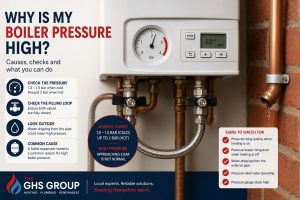
If your boiler pressure keeps rising, sits too high, or regularly reaches the red zone on the gauge, it could be a sign that something within your heating system needs attention. While some pressure changes are completely normal, consistently high pressure can lead to leaks, heating faults, and even component damage if ignored.
At The GHS Group, we regularly attend call-outs across Hampshire for boiler pressure issues, and in many cases, the fault can be narrowed down with a few simple checks.
What Boiler Pressure Should Be?
Most sealed central heating systems in UK homes should operate at:
- 1.0 – 1.5 bar when cold
- Around 2 bars when the heating is running
If your boiler is climbing towards 3 bar, losing pressure afterwards, or discharging water outside, there is likely a fault somewhere within the system.
Common Causes of High Boiler Pressure
- The System Has Been Overfilled
The simplest cause is that too much water has been added through the filling loop. This often happens after bleeding the radiators or topping up the system.
- Failed Expansion Vessel
This is one of the most common faults we see.
The expansion vessel absorbs the increase in water volume as your heating system warms up. If the vessel loses its air charge or the internal diaphragm fails:
- Pressure rises rapidly when the heating comes on
- Pressure may drop low once cold
- Water may discharge outside through the pressure relief pipe
- Filling Loop Left Open or Passing
The filling loop should remain fully closed once the system is topped up.
If a valve has been left slightly open — or has failed internally — mains water can continue to enter the heating system, causing pressure to creep upwards.
- Faulty Pressure Reducing Valve
Some boilers and sealed systems use pressure-reducing valves, which can occasionally fail, leading to over-pressurisation of the system.
- Heat Exchanger Fault
Less common, but more serious. A failed heat exchanger can allow mains pressure water into the sealed heating circuit, continually increasing pressure.
What You Can Safely Check Yourself
Before calling an engineer, there are a few safe checks you can carry out yourself.
Check Boiler Pressure When Cold
Turn the heating off for at least an hour and check the gauge.
- Normal: around 1–1.5 bar
- High: above 2 bars when cold
- Very high: approaching 3 bar
Then switch the heating back on and monitor the pressure.
If the pressure rises quickly once hot, it often points towards an expansion vessel issue.
Check the Filling Loop
Most combi boilers have a silver braided hose underneath called the filling loop.
Make sure:
- Both valves are fully closed
- Lever handles sit at 90° to the pipe
- Nobody has accidentally left it open
If pressure still rises after fully closing it, the valve may be internally faulty.
Check for Water Outside
Look for a small copper pipe outside your property.
If water drips from this pipe while the heating is running, your pressure relief valve has likely opened due to excessive pressure.
This is commonly linked to:
- expansion vessel faults
- over-pressurisation
- failed PRVs
Avoid Doing These Things
- Don’t remove the boiler casing
- Don’t repeatedly top up the system
- Don’t continuously release pressure
- Don’t interfere with gas components
Repeatedly adding or removing pressure often masks the real fault rather than solving it.
Need Help With Boiler Pressure Problems?
If your boiler pressure keeps rising, your heating system may require professional diagnosis before further damage occurs.
At The GHS Group, we provide boiler repairs, heating diagnostics, expansion vessel repairs and central heating services across Hampshire and the surrounding areas.
Whether it’s a simple filling loop issue or a more complex boiler fault, we can help get your heating system running safely and efficiently again.
📞 Call today for advice or to book an engineer.

Leave a Reply