

Why Is My PRV Letting By? How Water Pressure Drops Can Leave You Without Heating and Hot Water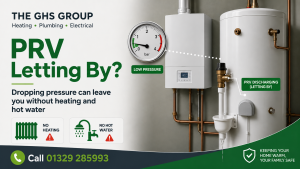
When your heating system or hot water cylinder starts losing pressure, it can quickly become more than a minor inconvenience. One common cause is a PRV letting by. This means the pressure relief valve is allowing water to pass when it should be sealed.
At first, it may look like a small drip from a copper discharge pipe or tundish. But over time, that small discharge can cause your system pressure to drop, leaving
you with no heating, no hot water, or a boiler that keeps locking out.
What Is a PRV?
A PRV, or pressure relief valve, is a safety device fitted to boilers, heating systems and unvented hot water cylinders.
Its job is to protect the system if the pressure gets too high. When pressure rises above the valve’s set limit, the PRV opens and safely discharges water.
The problem starts when the valve does not fully close again, or when the system keeps over-pressurising and forcing the PRV to open.
What Does “PRV Letting By” Mean?
When a PRV is “letting by”, it means water is passing through the valve even when it should be shut.
You may notice:
- Water dripping from an external copper pipe
- Water passing through the tundish on an unvented cylinder
- Boiler pressure dropping regularly
- The boiler needing to be topped up often
- Heating or hot water failing
- Fault codes or boiler lockouts
- Radiators not warming properly
A PRV letting by should never be ignored. It is usually a sign that something else needs checking.
How Can a PRV Cause Pressure to Drop?
Your heating system needs a set amount of water pressure to operate correctly. On many domestic boilers, this is often around 1 to 1.5 bar when cold, although the correct pressure depends on the appliance and system design.
If the PRV is passing water, the system slowly loses pressure. Once the pressure drops too far, the boiler may shut down to protect itself.
This can leave you with:
No Heating
If the boiler detects low system pressure, it may not fire up. Even if the boiler tries to run, poor circulation can stop radiators heating properly.
No Hot Water
On a combi boiler, low pressure can prevent the boiler from operating correctly. On stored hot water systems, pressure problems can also affect the cylinder, controls or system circulation.
Repeated Boiler Lockouts
If the underlying cause is not fixed, you may keep topping up the system, only for the pressure to drop again. This can lead to repeated faults and callouts.
Why Does a PRV Start Letting By?
There are several common reasons.
1. Expansion Vessel Problems
The expansion vessel absorbs pressure changes as water heats and expands. If the vessel has lost its charge, failed internally, or is undersized, pressure can rise too high when the system heats up.
The PRV then opens to release pressure. Once it has opened, dirt or scale can stop it sealing properly again.
2. System Over-Pressurising
If the filling loop has been left open, or a pressure reducing valve is passing, pressure may continue to rise. The PRV may be doing its job by discharging excess pressure.
In this case, simply replacing the PRV may not solve the problem.
3. Dirt or Scale on the Valve Seat
Once a PRV opens, debris can sit on the valve seat. This prevents the valve from closing fully, causing a constant drip.
4. Faulty or Worn PRV
Like any mechanical part, a PRV can fail over time. Springs weaken, seals wear, and valves may no longer hold pressure correctly.
5. Unvented Cylinder Pressure Issues
On an unvented hot water cylinder, discharge through the tundish could be linked to the expansion vessel, pressure reducing valve, expansion relief valve, or temperature and pressure relief valve.
This should always be checked by someone competent to work on unvented hot water systems.
Why Topping Up the Pressure Is Not a Proper Fix
Topping up your boiler may get it working again temporarily, but it does not solve the cause of the pressure loss.
If the PRV is still letting by, the pressure will continue to drop. Repeatedly topping up the system can also introduce fresh oxygen into the heating system, which may increase the risk of corrosion, sludge and future component failure.
A pressure drop is a symptom. The important part is finding out why the pressure is dropping.
What Should Be Checked?
A proper investigation may include:
- Checking the boiler pressure cold and hot
- Inspecting the PRV discharge pipe
- Checking whether water is passing from the PRV
- Testing the expansion vessel charge
- Checking for signs of system over-pressurising
- Looking for leaks on radiators, pipework and valves
- Checking the filling loop is fully closed
- Inspecting the pressure reducing valve where fitted
- Checking unvented cylinder safety controls where applicable
At The GHS Group, we do not believe in guesswork. We investigate the cause properly before recommending a repair.
Can You Still Use the Heating or Hot Water?
If your PRV is discharging, it is best to arrange an inspection. A small drip can quickly become a bigger issue, especially if pressure is dropping regularly.
You should never cap off, block, isolate or alter a safety discharge pipe. It is there to protect the system and your home.
The GHS Group Can Help
If your boiler pressure keeps dropping, your PRV is letting by, or you are losing heating and hot water, our team can help diagnose the issue safely and correctly.
We cover boiler repairs, heating faults, unvented hot water cylinder issues and pressure problems across Gosport, Fareham and the surrounding Hampshire area.
Call The GHS Group on 01329 285993 to book a heating or hot water fault inspection.

Leave a Reply