

During a recent routine commercial catering call-out, we found something that should immediately raise concern: an air pressure switch on a
commercial catering gas interlock that had been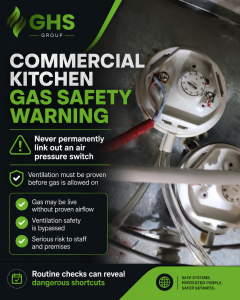 linked out.
To some people, this may look like a small wiring shortcut. In reality, it can remove one of the key safety functions designed to protect staff, customers and the business.
Commercial kitchens rely on good ventilation. Gas catering appliances produce heat, fumes and products of combustion. The gas interlock system ensures the gas supply is available only when the ventilation system is operating correctly.
If part of that safety system is permanently bypassed, the kitchen may continue to operate even when the extract or make-up air system is not doing its job.
What Does an Air Pressure Switch Do on a Gas Interlock?
On a commercial catering gas interlock, an air-pressure switch is typically used as a ventilation-proving device.
It is usually connected to the ductwork using small sensing tubes. When the extract fan or ventilation system is operating correctly, it creates a pressure difference. The air pressure switch detects that pressure difference and sends a signal back to the gas interlock panel.
In simple terms, the air pressure switch helps prove that air is moving.
A typical sequence is:
- The kitchen extract or supply fan starts.
- Air movement creates a pressure difference in the duct.
- The air pressure switch proves that pressure difference.
- The gas interlock panel receives the proving signal.
- The gas solenoid valve opens, allowing gas to the appliances.
- If the airflow fails, the switch should drop out, isolating the gas.
This is important because a fan having electrical power does not always mean the ventilation is working properly. A fan can be powered but still have poor airflow due to blocked filters, a failed belt, a closed damper, grease build-up, blocked ductwork or poor make-up air.
Why Commercial Kitchen Ventilation Proving Matters
Commercial kitchen ventilation is not just about comfort. It is part of gas safety.
A good ventilation system helps remove heat, steam, grease-laden air and products of combustion. If the ventilation is not working correctly, the kitchen environment can become unsafe.
Potential risks include:
- Carbon monoxide build-up
- Poor combustion
- Heat and fumes are building up in the kitchen
- Grease and smoke are not being removed correctly
- Staff exposure to unsafe air conditions
- Increased fire risk
- Gas appliances operating when the ventilation is not proven
The purpose of a gas interlock is to stop gas-fired catering appliances from being used without suitable ventilation.
What Does “Linked Out” Mean?
When an air pressure switch is “linked out”, it usually means the proving circuit has been bypassed with a wire link.
This can make the interlock panel think the ventilation has been proven, even when it has not.
The gas solenoid may then open regardless of whether the extract system is actually working.
That is the problem.
The interlock may look operational, lights may come on, and the gas may be available, but the system is no longer properly providing the ventilation.
In engineering terms, the safety control has effectively been turned into a dummy link.
Why Permanently Linking Out an Air Pressure Switch Is Dangerous
Permanently bypassing an air pressure switch is not a repair. It removes a safety function.
If the switch is linked out, the gas supply may be available even if:
- The fan has failed
- Filters are blocked
- A fan belt has snapped
- The ductwork is restricted
- The damper is closed
- Make-up air is inadequate
- The pressure tubes are blocked or disconnected
- The airflow is below the required level
This can create a dangerous situation in a working commercial kitchen.
A temporary link may sometimes be used by a competent commercial catering gas engineer as part of controlled fault finding, but it should not be left in place as a permanent solution.
If the system cannot demonstrate proper ventilation, the fault needs to be diagnosed and repaired.
Common Air Pressure Switch and Interlock Faults
There are several reasons why an air pressure switch may fail to function correctly.
Common issues include:
- Blocked pressure tubes
- Grease contamination
- Tubes connected to the wrong ports
- Damaged or split sensing tubes
- Incorrect pressure switch setting
- Poor airflow through the ductwork
- Blocked extract filters
- Failed fan motor
- Failed fan belt
- Loose wiring
- Faulty interlock panel input
- Failed air pressure switch
- Poor make-up air into the kitchen
Finding and repairing the real fault is the only safe route. Bypassing the switch only hides the problem.
What We Found on Site
On this routine call-out, the air-pressure switch arrangement had clearly been tampered with.
This kind of find is exactly why regular commercial gas safety checks and proper maintenance are so important. A safety device can be present, but if it has been bypassed, damaged or incorrectly wired, it may not be doing the job it was installed to do.
A commercial catering gas interlock should not simply allow gas because a link has been fitted. It should prove that the ventilation system is operating correctly.
What Should a Business Owner Do?
If you run a commercial kitchen, restaurant, pub, café, school kitchen or catering site, it is worth asking a simple question:
Is my gas interlock actually providing ventilation, or is it just switching on?
You should arrange an inspection by a suitably qualified commercial catering gas engineer if:
- The gas comes on even when the extract is off
- The interlock has been bypassed
- You can see loose links or modified wiring
- The extract system is noisy or weak
- Staff complain about fumes, heat or smells
- Appliances are showing poor combustion signs
- The CP42 inspection has flagged issues
- The ventilation system has not been serviced
- You are unsure whether the interlock is working correctly
Commercial kitchen gas safety is not an area for shortcuts.
Do Not Bypass Safety Controls
Gas interlocks, solenoid valves and air pressure switches are there for a reason. They are designed to protect people and property.
If a safety device has failed, the answer is not to link it out and carry on using the kitchen. The answer is to find out why it has failed, repair the system and prove that it operates correctly.
Leaving a commercial catering gas interlock permanently linked out can create serious safety, compliance, insurance and liability issues.
Commercial Catering Gas Safety Help from GHS Group
At GHS Group, we support commercial kitchens with gas safety inspections, CP42 checks, gas interlock testing, ventilation proving issues, catering equipment faults and planned maintenance.
If you are unsure whether your commercial kitchen gas interlock is working correctly, do not leave it to chance.
For commercial catering gas safety support across Gosport, Fareham, Portsmouth, Hampshire and surrounding areas, contact GHS Group today.
Call 01329 285993

Leave a Reply