

Modern condensing boilers produce water as a byproduct of combustion.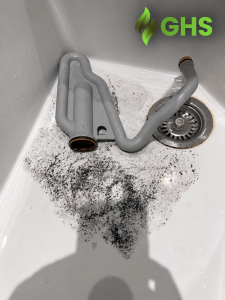
That water, known as condensate, has to be safely collected and drained away. One of the components responsible for doing this is the condensate trap.
It may be a relatively small part of the boiler, but if it becomes dirty or blocked, it can cause surprisingly serious problems.
This is one of the reasons a proper boiler service should involve more than a quick visual inspection.
What does a condensate trap do?
A condensing boiler extracts additional heat from the products of combustion.
As the flue gases cool, water vapour condenses into liquid. This liquid is slightly acidic and must be safely removed from the boiler.
The condensate trap helps:
- Collect condensate from inside the boiler
- Allow it to drain away safely
- Maintain the correct seal within the appliance
- Prevent combustion gases from escaping through the condensate pipe
The exact design varies between manufacturers, but the principle is similar.
Why does a condensate trap get dirty?
Over time, debris can accumulate inside the boiler and condensate system.
Depending on the appliance, this can include:
- Combustion deposits
- Dust and dirt
- Corrosion products
- Sludge-like material
- Small particles washed down from the heat exchanger
If enough material collects in the trap, the condensate may no longer drain properly.
The photograph from one of our recent services is a good example of just how much debris can accumulate.
What can happen if the condensate trap becomes blocked?
A blocked or restricted condensate trap can cause several problems.
1. The boiler may lock out
Modern boilers contain safety controls designed to shut the appliance down if something is wrong.
If condensate cannot drain correctly, the boiler may eventually register a fault and stop operating.
That could leave the homeowner without heating or hot water.
2. Condensate can back up inside the boiler
If the drainage path is blocked, condensate may begin collecting where it should not.
That moisture can potentially affect internal components and contribute to corrosion or damage.
3. The heat exchanger can be affected
The main heat exchanger is one of the most important and expensive components inside a modern boiler.
Condensate needs to drain correctly from the heat exchanger.
If it is allowed to back up, it can contribute to poor operation and may eventually lead to more expensive problems.
4. Unusual noises may develop
Restricted condensate drainage can sometimes contribute to bubbling or gurgling noises from the appliance or condensate pipework.
While these sounds do not automatically confirm a blocked trap, they are worth investigating.
5. The boiler may become unreliable
A partially restricted trap may not immediately stop the boiler.
Instead, the homeowner may experience intermittent faults, unexplained lockouts or problems that appear and disappear.
That is why preventative servicing is so important.
Why should the condensate trap be checked during a boiler service?
A boiler service is intended to check that the appliance is operating safely and correctly.
The engineer should follow the manufacturer’s servicing instructions for that specific boiler.
Where the manufacturer’s procedure requires the condensate trap to be inspected, cleaned, or serviced, this should be included in the work.
This matters because simply checking combustion readings does not necessarily tell you the condition of components such as the condensate trap.
A boiler can appear to be operating correctly while dirt is gradually building up inside.
Why a proper boiler service should usually take more than 20 minutes
There is no universal time that every boiler service must take.
Different appliances require different procedures, and the boiler’s condition will also affect how much work is needed.
However, a thorough service involves more than removing the case, taking a reading and putting everything back together.
Depending on the boiler and the manufacturer’s requirements, servicing may involve:
- Checking the general condition of the appliance
- Inspecting the flue and ventilation arrangements
- Checking combustion
- Examining seals and internal components
- Checking the burner and heat exchanger where required
- Inspecting and cleaning the condensate trap
- Checking the condensate pipework
- Checking system pressure
- Checking safety devices
- Looking for signs of leaks, corrosion or deterioration
- Recording appropriate test results
If components need cleaning or further investigation, that naturally takes additional time.
The important point is not whether a service takes exactly 20, 30 or 45 minutes.
It is whether the correct checks have actually been completed.
What does this have to do with your boiler warranty?
Many boiler manufacturers offer extended warranties provided certain conditions are met.
These conditions often include having the boiler serviced annually by a suitably qualified engineer and keeping evidence of that servicing.
The exact terms vary between manufacturers, so homeowners should always check the warranty conditions for their particular boiler.
If a boiler develops a fault and there is evidence that required maintenance has not been carried out, this may complicate a warranty claim.
For example, if a component fails because the boiler has not been serviced in accordance with the manufacturer’s instructions, the manufacturer may investigate whether the warranty conditions have been met.
That is why servicing should not be treated purely as paperwork.
The aim is to maintain the appliance properly and provide a service record.
Is cleaning the condensate trap always required?
Not necessarily on every boiler and at every service.
Manufacturers specify different servicing procedures for different appliances.
Some traps are designed to be inspected or cleaned at particular intervals, while others may only need attention depending on their condition.
A competent engineer should follow the instructions for the particular make and model rather than applying exactly the same servicing routine to every boiler.
However, if the trap contains the sort of contamination shown in our photograph, it clearly needs attention.
Don’t wait for the boiler to stop working
One of the advantages of regular servicing is identifying problems before they lead to breakdowns.
Cleaning a dirty condensate trap during routine maintenance is generally far preferable to dealing with a boiler that has stopped working because condensate can no longer drain properly.
A service also gives the engineer an opportunity to identify other developing problems while the boiler is still operating.
When was your boiler last properly serviced?
If you are unsure when your boiler was last serviced, or you are concerned that previous servicing has been little more than a quick inspection, it may be worth having the appliance properly checked.
A good boiler service should be carried out in accordance with the manufacturer’s instructions and should focus on both safety and preventative maintenance.
The GHS Group provides boiler servicing, maintenance and repairs throughout Hampshire.
Call The GHS Group on 01329 285993.

Leave a Reply