

 Hard water is a common problem across many parts of Hampshire and the wider South of England. It contains naturally occurring minerals, mainly calcium and magnesium, which are harmless to drink but can create significant problems for plumbing and hot-water systems.
Over time, these minerals form limescale. That scale can build up inside pipes, on taps, within hot-water cylinders and around heating elements. In a domestic property, it can be inconvenient. In a busy commercial property, such as a public house, it can become a costly maintenance issue.
Protecting immersion heaters and hot-water cylinders
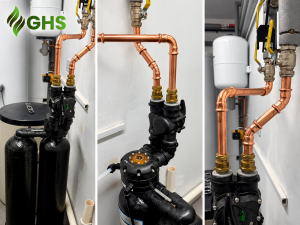
We recently installed a twin-tank water softener for a public house with an all-electric hot-water system.
Because the building relies on immersion heaters inside the hot-water cylinder, protecting those elements from scale is particularly important.
An immersion heater works by transferring heat directly into the stored water. If a thick layer of limescale builds up around the element, that scale acts as insulation. The heater has to work harder and remain energised for longer to transfer the same amount of heat.
That can contribute to:
- Reduced heating performance
- Increased strain on immersion heaters
- Premature element failure
- Longer recovery times for hot water
- Increased maintenance requirements
- Scale build-up within the cylinder and associated pipework
A correctly specified water softener significantly reduces the minerals responsible for this scale formation.
Why a twin-tank water softener can suit commercial premises
A twin-tank system is particularly useful where there is a regular demand for softened water.
With two resin vessels, one tank can continue supplying softened water while the other undergoes its regeneration cycle. This makes it well suited to commercial environments where interruptions to the softened-water supply are undesirable.
For a public house, reliable hot water is essential for kitchens, washrooms, cleaning and general day-to-day operation.
A thoughtful installation matters too
Installing the water softener is only part of the job. The surrounding pipework should also be designed with future servicing and maintenance in mind.
On this installation, particular attention was given to producing neat, accessible pipework and providing suitable isolation points around the equipment.
This is important because a water softener is a serviceable piece of equipment. At some point during its life it may need maintenance, adjustment or repair.
Good access means an engineer can work on the equipment without unnecessarily disturbing the rest of the plumbing system.
That can make future servicing quicker, cleaner and more straightforward.
What maintenance does a water softener need?
A modern water softener is generally reliable, but it should not simply be installed and forgotten.
Depending on the type of unit, water usage and manufacturer’s recommendations, future maintenance may include checking:
- Salt levels and the condition of the brine tank
- The control valve and regeneration cycle
- Seals, pistons and internal valve components
- Bypass and isolation valves
- Hose connections and drains
- Water hardness before and after the softener
- Resin condition as the system gets older
The salt level is particularly important. Most conventional softeners need salt to regenerate the resin that removes hardness minerals from the water.
Allowing the salt to run out means the unit may stop producing properly softened water.
What repairs might be needed in the future?
Like any mechanical water-treatment system, components can eventually wear.
Typical repairs might involve valve seals, internal pistons, injectors, brine components or control mechanisms. On older equipment, the resin itself may eventually require attention or replacement.
This is another reason we consider future maintenance when installing the equipment.
Providing sensible isolation valves, unions and accessible pipework can make the difference between a relatively straightforward repair and having to alter significant amounts of pipework simply to remove or service the unit.
Other benefits around the property
Although protecting the hot-water cylinder was a major reason for this installation, softened water can also help reduce scale throughout the building.
That can benefit:
- Taps and shower fittings
- Washing equipment
- Dishwashers and glasswashers
- Toilets and cistern valves
- Hot-water pipework
- Certain commercial kitchen appliances
- Other water-heating equipment
It can also reduce the familiar white scale deposits around taps, sinks and sanitaryware.
Is a water softener worth fitting?
In a hard-water area, it is certainly worth considering, particularly where expensive equipment relies on the water supply.
The question is not simply whether there is scale today, but what repeated exposure to hard water could do over the next five, ten or fifteen years.
For homes and businesses with stored hot-water systems, immersion heaters or high water usage, controlling scale can form an important part of preventative maintenance.
The system still needs to be correctly selected, installed and maintained, but protecting equipment from the outset is often preferable to repeatedly dealing with the effects of heavy limescale later.
Need advice on hard water?
The GHS Group can advise on water-softening systems for both domestic and commercial properties, including installation, servicing and repairs.
Call The GHS Group on 01329 285993

Leave a Reply